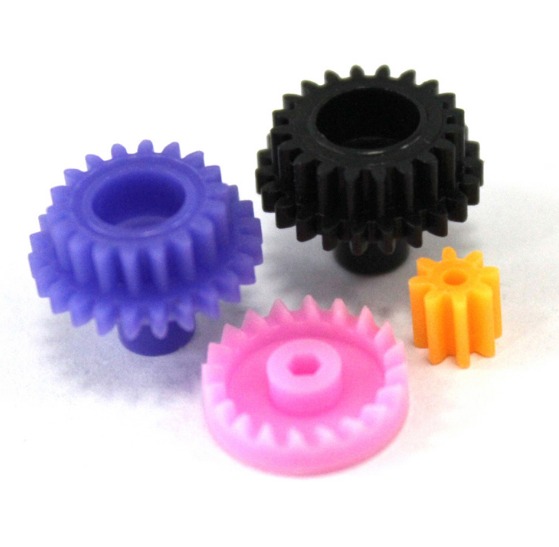
Plastic drive gears are everywhere. They spin inside your electric toothbrush, adjust your car’s power windows, and help drones fly smoothly. But they are not just cheap alternatives to metal. In many applications, plastic drive gears actually outperform metal—offering lighter weight, quieter operation, and better reliability in challenging environments.
This guide explores plastic drive gears: what they are, how they compare to metal, and how to select the right one for your application. Whether you design consumer products or industrial equipment, understanding these components helps you build better systems.
What Is a Plastic Drive Gear?
Basic Structure and Function
A plastic drive gear is a toothed wheel that transmits power and motion within a mechanical system. Its teeth interlock with other gears to change speed, increase torque, or alter direction. The gear receives input from a motor or other power source and transfers that energy to the driven components.
Common types include:
| Gear Type | Description | Typical Applications |
|---|---|---|
| Spur gear | Straight teeth, simple design | Small motors, appliances, toys |
| Helical gear | Angled teeth, smoother operation | Automotive, industrial machinery |
| Bevel gear | Conical shape, changes direction | Drills, differentials, power tools |
| Worm gear | Screw-like, high reduction ratios | Conveyors, elevators, precision positioning |
Materials That Make Them Work
Not all plastics are equal for gears. High-performance engineering plastics offer the strength, wear resistance, and stability needed:
- POM (Acetal/Delrin): High stiffness, low friction, excellent dimensional stability. The most common gear material.
- Nylon (PA): Self-lubricating, good strength, absorbs moisture—design must account for swelling.
- PEEK: High-temperature resistance (up to 250°C), exceptional strength, premium cost.
- ABS: Cost-effective, good impact resistance, lower strength than POM or nylon.
- Polycarbonate (PC): Tough, impact-resistant, less wear resistance than POM.
How Do Plastic Drive Gears Compare to Metal?
Side-by-Side Analysis
| Property | Plastic Drive Gears | Metal Drive Gears |
|---|---|---|
| Weight | 10–50 g typical | 50–200 g for same size |
| Density | 0.9–2.3 g/cm³ | 7.8–8.0 g/cm³ (steel) |
| Noise | 10–15 dB lower | Louder, requires damping |
| Wear resistance | Good with proper materials; 100,000+ cycles possible | Excellent with heat treatment |
| Cost per unit (10,000 units) | $0.50–$2.00 | $2.00–$5.00+ |
| Design flexibility | High—complex shapes, integrated features | Limited—machining constraints |
| Strength | Moderate; PEEK handles 5+ N·m | Very high; hundreds to thousands N·m |
| Temperature resistance | 80–100°C typical; PEEK to 250°C | 400–500°C+ |
| Corrosion resistance | Excellent | Requires coatings or stainless alloys |
| Lubrication | Often self-lubricating | Usually required |
Weight Matters
A plastic gear weighs about one-sixth of a steel gear of the same size. For battery-powered devices, this directly affects runtime. For portable tools, it affects user fatigue. For aerospace, every gram counts.
A drone manufacturer switched from metal to plastic gears in their gimbal system. The weight reduction extended flight time by 12 minutes—a significant improvement.
Noise Reduction
Plastic dampens vibration. Metal transmits it. Testing shows plastic gears operate 10–15 decibels quieter than metal equivalents under the same conditions. In household appliances and office equipment, this difference matters to users.
Cost-Effectiveness at Scale
Injection molding produces plastic gears at high volume with low per-unit cost. A run of 10,000 plastic gears might cost $0.50 per unit. The same quantity of metal gears could cost $2–5 per unit—four to ten times more.
For mass-produced consumer products, this cost advantage drives design decisions.
What Are the Limitations of Plastic Drive Gears?
Strength and Load Capacity
Plastic gears cannot match metal for high-load applications. While PEEK gears handle up to 5 N·m in some designs, industrial steel gears handle hundreds or thousands of N·m. For heavy machinery, automotive transmissions, or high-torque industrial equipment, metal remains necessary.
Temperature Sensitivity
Most common plastics begin losing mechanical properties above 80–100°C. ABS softens at 90°C. POM maintains properties longer but still degrades above 100°C. For high-temperature environments, specialized plastics like PEEK or PPS are required—but they cost significantly more.
Moisture Effects
Hygroscopic plastics like nylon absorb moisture. A nylon gear in high humidity can swell by 0.5–1.0%, changing dimensions and affecting mesh with mating gears. For precision applications, this must be accounted for in design, or non-hygroscopic materials like POM should be used.
Wear Over Time
While plastic gears wear well under moderate loads, they eventually wear. In a lab test, POM gears lasted 100,000 cycles with minimal wear. Steel gears in similar conditions might last millions of cycles. For high-cycle, high-load applications, metal still wins.
Where Do Plastic Drive Gears Excel?
Consumer Electronics
- Smartphone camera mechanisms: Micro plastic gears enable autofocus and optical zoom
- Electric toothbrushes: Gears reduce motor speed while multiplying torque
- Drones: Lightweight gears extend flight time
- Printers: Quiet gears drive paper feed and print head movement
Automotive Applications
- Power windows and seat adjusters: Quiet, corrosion-resistant operation
- HVAC actuators: Precise positioning of air flow controls
- Electric vehicle components: Weight reduction improves range
Medical Devices
- Insulin pumps: Precision gears control dosage delivery
- Surgical robots: Quiet, precise motion for delicate procedures
- Diagnostic equipment: Reliable operation in clinical settings
Industrial Equipment
- Packaging machinery: Self-lubricating gears reduce maintenance
- Conveyor systems: Quiet, corrosion-resistant operation
- Small pumps: Chemical-resistant gears for fluid handling
How Do You Choose the Right Plastic Drive Gear?
Assess Operating Environment
Temperature: Standard plastics work to 80–100°C. For higher temperatures, specify PEEK (250°C) or PPS (200°C).
Humidity: Nylon absorbs moisture. For humid environments, choose POM or PEEK.
Chemical exposure: PTFE or PEEK resist aggressive chemicals. Standard plastics may degrade.
Calculate Load and Torque Requirements
Torque (T = F \times r), where (F) is force and (r) is gear radius.
Example: A force of 50 N applied at 0.1 m radius = 5 N·m torque.
| Torque Range | Recommended Material |
|---|---|
| < 1 N·m | POM, ABS |
| 1–5 N·m | Nylon, POM (reinforced) |
| 5–15 N·m | PEEK, glass-filled nylon |
| > 15 N·m | Consider metal |
Determine Precision Needs
| Application | Tolerance | Manufacturing Method |
|---|---|---|
| Consumer electronics | ±0.1–0.2 mm | Injection molding |
| Precision instruments | ±0.05 mm | Precision molding |
| Medical devices | ±0.02–0.05 mm | Machining or high-precision molding |
| Aerospace | ±0.01 mm | Machining |
Consider Cost
Balance material cost against performance requirements:
- Low cost, moderate performance: ABS or POM
- Good balance: Nylon
- High performance, higher cost: PEEK
- Highest performance, highest cost: Machined metal
For high-volume production, the lower per-unit cost of plastic often justifies material selection even if the plastic itself costs more per kilogram than metal alternatives.
How Does Yigu Technology Approach Plastic Drive Gears?
At Yigu Technology, we manufacture plastic drive gears across consumer, automotive, medical, and industrial applications. Our approach combines material expertise with precision manufacturing.
Material selection: We help clients choose the right plastic for their environment. For a high-torque medical device, we specified PEEK gears that met strength requirements while maintaining biocompatibility.
Precision manufacturing: Our injection molding processes achieve tolerances down to ±0.02 mm. For critical applications, we machine gears to ±0.005 mm.
Design optimization: We work with clients to optimize gear geometry for manufacturability and performance. For a drone manufacturer, we redesigned a gear set that reduced weight by 15% while maintaining torque capacity.
Quality assurance: Every gear batch undergoes dimensional inspection, material verification, and functional testing as required.
Conclusion
Plastic drive gears unlock efficiency and reliability across countless applications. Their light weight, quiet operation, corrosion resistance, and cost-effectiveness make them superior to metal in many scenarios. They are not universal—high-load, high-temperature, or ultra-high-cycle applications still demand metal. But for the vast range of applications where plastic works, it often works better.
Selecting the right plastic drive gear means matching material to environment, calculating loads accurately, specifying appropriate precision, and balancing cost against performance. When chosen correctly, plastic drive gears deliver reliable performance for thousands of cycles—quietly, efficiently, and economically.
Frequently Asked Questions
What load can plastic drive gears withstand?
Load capacity depends on material, design, and operating conditions. POM gears typically handle 50–100 N tangential force. PEEK gears can handle higher loads—up to 5 N·m torque in some applications. For higher loads, consider metal gears or reinforced plastics.
What is the lifespan of plastic drive gears?
Under normal conditions (room temperature, moderate load, proper lubrication), POM gears last 10,000–100,000 cycles. High temperatures or heavy loads reduce lifespan. Proper material selection and operating conditions maximize life.
Can plastic drive gears replace metal gears?
In many applications, yes. Plastic gears excel where weight, noise, corrosion resistance, and cost matter. For high-load, high-temperature, or ultra-high-cycle applications, metal remains necessary. The choice depends on your specific requirements.
What materials are best for plastic drive gears?
POM (acetal) is the most common—good stiffness, low friction, dimensional stability. Nylon offers self-lubrication and strength but absorbs moisture. PEEK provides high-temperature resistance and exceptional strength at higher cost. ABS works for low-load, cost-sensitive applications.
How do I extend the life of plastic drive gears?
Operate within specified temperature and load limits. Ensure proper lubrication—many plastics are self-lubricating, but some benefit from compatible lubricants. Keep the environment clean. For nylon gears, account for moisture swelling in humid conditions. Regular inspection catches wear early.
Contact Yigu Technology for Custom Manufacturing
Need plastic drive gears for your application? At Yigu Technology, we combine material expertise with precision manufacturing to deliver gears that perform. From material selection to final inspection, we help you get the right solution.
Contact us today to discuss your plastic drive gear requirements.