Introduction
You have a design. It looks perfect on the screen. But when you think about making it, one question looms: what material should you use? Pick the wrong one, and your part might fail in service. Pick an overly expensive one, and your project budget evaporates. Pick a difficult one, and machining takes twice as long.
Material selection is not just a technical decision. It is the intersection of design intent, functional performance, manufacturing efficiency, and cost. Engineers and procurement managers alike face this choice daily.
At Yigu Technology, we machine hundreds of materials every year. We have seen what works and what causes headaches. This guide cuts through the complexity. We will walk you through the most suitable metals, plastics, and composites, explain the properties that matter, and give you a practical framework for making the right choice.
What Materials Are Suitable for CNC Machining?
The Three Major Families
CNC machining is remarkably versatile. The process can handle materials ranging from soft waxes used for casting patterns to ultra-hard superalloys that resist deformation at 1000°C.
Suitable materials fall into three broad categories:
| Family | Examples | Key Characteristics |
|---|---|---|
| Metals & Alloys | Aluminum, steel, stainless, brass, titanium | Strength, conductivity, durability |
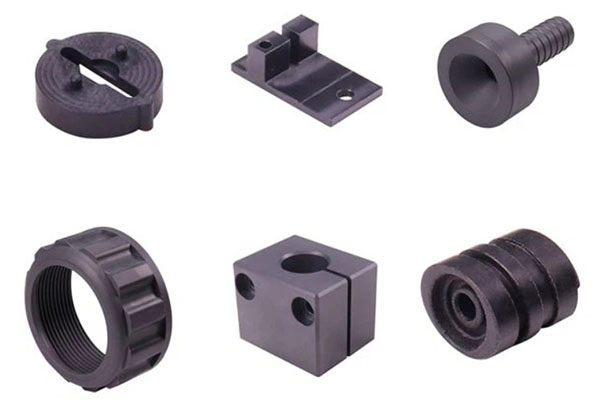
| Engineering Plastics | ABS, nylon, PEEK, acetal, polycarbonate | Lightweight, corrosion-proof, insulating |
| Composites | Carbon fiber, fiberglass | High strength-to-weight, specialized |
The common requirement across all: the material must be rigid enough to hold without excessive deflection and must produce manageable chips or swarf. Beyond that, the possibilities are vast.
What Makes a Material "Machinable"?
Machinability is not a single property. It is a composite rating that reflects:
- Chip formation: Does the material produce small, broken chips or long, stringy ribbons?
- Tool wear: How quickly does it dull the cutting edge?
- Surface finish: Can you achieve the required smoothness?
- Cutting forces: Does it resist cutting or cut easily?
A material with good machinability (like 6061 aluminum) allows high speeds, long tool life, and excellent finishes. A material with poor machinability (like Inconel) requires specialized tools, slower speeds, and careful process control.
What Material Properties Should You Consider?
Machinability
This is your starting point for manufacturing efficiency. Materials with high machinability ratings reduce cycle times and tooling costs.
| Rating | Meaning | Examples |
|---|---|---|
| 5 (Excellent) | Cuts easily, long tool life | Brass, 6061 aluminum, acetal |
| 4 (Very Good) | Good speeds, moderate tool wear | 7075 aluminum, mild steel |
| 3 (Good) | Requires careful parameters | Stainless steel 304, nylon |
| 2 (Fair) | Specialized tooling needed | Titanium, PEEK |
| 1 (Poor) | Demanding, slow, high tool wear | Inconel, hardened tool steel |
Strength and Hardness
These properties determine what the part can withstand in service.
- Tensile strength: How much pulling force before failure
- Yield strength: How much stress before permanent deformation
- Hardness: Resistance to indentation and wear
Higher strength and hardness generally mean slower machining and shorter tool life. The trade-off is part durability.
Thermal Properties
Two thermal properties matter during machining:
| Property | Why It Matters |
|---|---|
| Thermal conductivity | High conductivity (like aluminum) pulls heat away from the cutting zone, allowing higher speeds |
| Coefficient of thermal expansion | Materials that expand significantly with heat can cause dimensional issues during machining |
Plastics and stainless steels have low thermal conductivity. Heat stays in the cutting zone, requiring careful management to avoid melting or work hardening.
Chemical and Corrosion Resistance
Will the part face moisture, chemicals, or outdoor exposure? This dictates material selection.
- Stainless steel: Excellent corrosion resistance for medical, marine, food processing
- Aluminum: Good natural corrosion resistance; improved with anodizing
- Carbon steel: Requires coating or painting for outdoor use
- Plastics: Naturally corrosion-proof
Cost and Availability
Material cost is a direct input. Premium materials can be 10–15 times more expensive than common alternatives.
| Material | Relative Cost (per kg) | Availability |
|---|---|---|
| 6061 Aluminum | 1x (baseline) | Widely available |
| Mild Steel | 0.8x | Widely available |
| 304 Stainless | 2–3x | Good |
| 7075 Aluminum | 3–4x | Good |
| Brass | 4–5x | Good |
| Titanium 6Al-4V | 10–15x | Limited forms |
| PEEK | 15–20x | Limited forms |
Also consider stock sizes. A material only available in large plates may force you to buy more than you need, increasing waste.
Which Metal Alloys Offer the Best Machinability?
Aluminum: The Machinist's Favorite
Aluminum is the most common CNC material for good reason. It machines beautifully, offers excellent strength-to-weight, and resists corrosion.
| Alloy | Key Properties | Machinability | Best Applications |
|---|---|---|---|
| 6061-T6 | Good strength, excellent corrosion resistance, high thermal conductivity | Excellent | Prototypes, automotive, aerospace frames, consumer electronics |
| 7075-T6 | Very high strength (comparable to steel), good fatigue resistance | Good (harder than 6061) | Aerospace structural parts, high-performance bicycle components |
| 2024 | High strength, good fatigue resistance | Good | Aircraft structures, rivets |
Real-World Example:
A client needed a lightweight structural bracket for a drone. 6061 aluminum provided the strength-to-weight ratio, machined quickly, and anodized well for corrosion protection. The part cost 40% less than the titanium alternative and met all performance requirements.
Steel: Strength and Versatility
Steel offers the highest strength at the lowest cost. The trade-off is weight and potential corrosion.
| Alloy | Key Properties | Machinability | Best Applications |
|---|---|---|---|
| AISI 1045 (mild) | Good tensile strength, can be heat treated, cost-effective | Good | Shafts, gears, bolts, general machinery |
| AISI 4140 (tool) | High strength, excellent toughness, heat treatable | Good (when annealed) | Dies, molds, high-stress automotive parts |
| AISI 1215 | Free-machining grade, excellent surface finish | Outstanding | High-volume screw machine parts |
Machining tip: Machine steel in the annealed (soft) state whenever possible. Heat treat to final hardness after rough machining, then finish with hard turning or grinding if tolerances are tight.
Stainless Steel: Corrosion Resistance
Stainless steel combines strength with excellent corrosion resistance. It is more challenging to machine than mild steel due to work hardening.
| Alloy | Key Properties | Machinability | Best Applications |
|---|---|---|---|
| 304 | General-purpose stainless, good corrosion resistance | Fair (work hardens) | Medical devices, food processing, marine hardware |
| 316 | Superior corrosion resistance (marine grade) | Fair | Chemical equipment, marine components |
| 303 | Free-machining version, good corrosion resistance | Good | Fittings, shafts, where machining is intensive |
Machining tip: Use sharp tools, avoid dwell (stopping the tool in the cut), and maintain consistent feed rates. Work-hardened stainless can quickly dull tools.
Brass and Copper: Conductivity and Machinability
Brass and copper offer excellent machinability and conductivity.
| Alloy | Key Properties | Machinability | Best Applications |
|---|---|---|---|
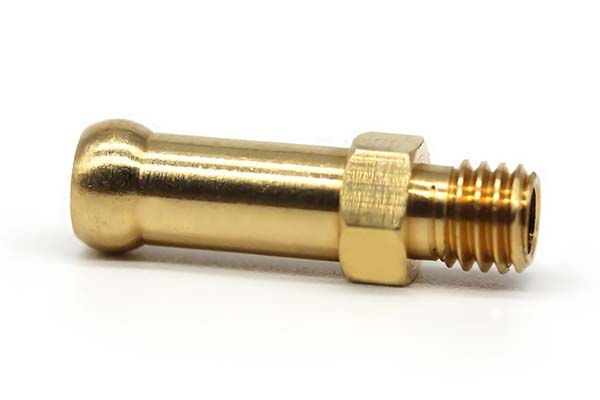
| C360 (free-cutting brass) | Excellent corrosion resistance, high thermal conductivity, superb finish | Outstanding | Plumbing fittings, electrical connectors, decorative hardware |
| C110 (electrolytic copper) | Highest electrical conductivity | Fair (gummy) | Bus bars, electrical components, heat sinks |
Expert Insight:
In a recent project for a precision optical mount, we needed exceptional dimensional stability. Aluminum 6061 was the first thought, but its thermal expansion coefficient posed a risk in varying lab temperatures. We switched to C360 brass, which offered superior thermal stability during machining and in the application. The result: a first-pass-success part with no post-machining distortion.
Titanium: High Performance, High Challenge
Titanium offers the highest strength-to-weight ratio and excellent biocompatibility. It is also among the most challenging materials to machine.
| Alloy | Key Properties | Machinability | Best Applications |
|---|---|---|---|
| Grade 5 (Ti6Al4V) | Very high strength, heat resistant, biocompatible | Poor (requires specialized tools) | Aerospace structural parts, medical implants, high-performance automotive |
Machining tip: Use sharp, positive-rake carbide tools. Maintain constant feed—dwell causes work hardening. High-pressure coolant is essential for chip evacuation and heat management.
Can Engineering Plastics Meet CNC Demands?
The Unique Value of Plastics
Engineering plastics are not cheap substitutes. They offer properties metals cannot match:
- Lightweight (often 1/5 the density of steel)
- Corrosion-proof
- Electrically insulating
- Often allow faster machining speeds
POM (Acetal / Delrin): The Machinist's Plastic
Acetal is widely regarded as the best plastic for precision machining.
| Property | Value |
|---|---|
| Dimensional stability | Excellent—low moisture absorption |
| Friction | Low, self-lubricating |
| Machinability | Outstanding—cuts cleanly, produces fine finish |
| Applications | Gears, bushings, jigs, fixtures, precision components |
Nylon (PA 6/66): Tough and Wear-Resistant
Nylon offers toughness, wear resistance, and some flexibility.
| Property | Value |
|---|---|
| Strength | Good, especially for impact |
| Wear resistance | Excellent |
| Challenge | Hygroscopic—absorbs moisture, affecting dimensions |
| Applications | Gears, bearings, wear pads, structural components |
Machining tip: Condition nylon in a controlled humidity environment before machining critical dimensions. Parts can swell 0.5–1.0% after moisture absorption.
PEEK: The High-Performance Superstar
PEEK (Polyether Ether Ketone) is a high-performance plastic that handles conditions where other plastics fail.
| Property | Value |
|---|---|
| Continuous use temperature | 260°C |
| Chemical resistance | Excellent—resists almost all chemicals |
| Biocompatibility | Suitable for medical implants |
| Machinability | Fair—requires sharp tools, careful heat management |
| Applications | Aerospace components, medical implants, semiconductor tooling, high-temperature electrical parts |
ABS and Polycarbonate: Prototyping and Enclosures
These common plastics are ideal for prototypes and non-structural parts.
| Material | Properties | Applications |
|---|---|---|
| ABS | Tough, impact-resistant, easy to machine | Enclosures, prototypes, consumer products |
| Polycarbonate (PC) | High impact strength, transparent, good heat resistance | Machine guards, transparent enclosures, high-impact parts |
Plastic Machining Challenges
The main challenge with plastics is heat management. Unlike metals, plastics do not dissipate heat well. Without proper strategies:
- Material can melt and gum up tools
- Internal stresses can develop, causing warping
- Surface finish degrades
Solutions:
- Use sharp tools with polished flutes
- Apply compressed air or mist coolant
- Avoid dwelling in the cut
- Consider stress-relieving annealing for large parts
How Are Composite Materials Revolutionizing CNC?
What Are Composites?
Composites combine a polymer matrix (like epoxy) with reinforcing fibers. The result: materials with exceptional strength-to-weight ratios—often stronger than steel at a fraction of the weight.
| Type | Matrix | Reinforcement | Applications |
|---|---|---|---|
| Carbon fiber (CFRP) | Epoxy | Carbon fibers | Aerospace, racing cars, sporting goods |
| Fiberglass (GFRP) | Polyester, epoxy | Glass fibers | Boat hulls, wind turbine blades, pipes |
Machining Composites: A Specialty
CNC machining is the primary method for finishing composite parts after molding. Operations include:
- Drilling holes for fasteners
- Trimming edges to final dimensions
- Achieving tight-tolerance features
Challenges:
- Abrasive fibers: Carbon fibers rapidly wear standard tooling
- Delamination: Improper cutting can separate layers
- Dust: Carbon fiber dust is conductive and harmful if inhaled
Solutions:
- PCD (polycrystalline diamond) tools: Essential for production runs
- Optimized feeds and speeds: Prevent delamination
- Climb milling: Reduces fiber pull-out
- Dust extraction: Required for operator safety
Real-World Example:
We recently machined attachment points on a carbon fiber drone arm. The goal: create lightweight, strong interfaces for motor mounts without compromising the cured laminate. The solution: a custom vacuum fixture to hold the part without crushing it, and diamond-coated end mills to cut cleanly. The result: a perfect interface with no delamination.
How to Optimize Material Selection for Cost and Quality?
A Decision Framework
Follow this process to select the optimal material:
Step 1: Define Non-Negotiables
List absolute requirements. Examples:
- "Must withstand 200°C continuous"
- "Must be FDA compliant for food contact"
- "Must have tensile strength > 500 MPa"
- "Must not corrode in saltwater"
This narrows the field dramatically.
Step 2: Evaluate Machinability vs. Performance
A stronger, harder alloy may meet the non-negotiables but double machining time and cost. Sometimes, a slightly "less ideal" material that machines beautifully results in a more reliable and affordable part.
Step 3: Consider the Entire Process
Does the material require post-processing? For example:
- 7075 aluminum often needs anodizing for corrosion protection
- Carbon steel needs coating or plating
- Plastics may need annealing for stress relief
A corrosion-resistant plastic might be a simpler, total-cost solution than a metal that requires coating.
Step 4: Prototype Strategically
Use a less expensive, easy-to-machine material for form-and-fit prototypes. Examples:
- 6061 aluminum instead of 7075 for initial fit checks
- ABS instead of PEEK for housing prototypes
For functional testing, you must use a grade close to the final material to validate performance.
Case Study: Choosing the Right Material for Sensor Housings
The Situation:
A client needed 500 sensor housings. The initial spec was 316 stainless steel for extreme corrosion resistance. The environment was industrial but only mildly corrosive.
The Analysis:
- 316 stainless: Material cost high, machining slow (machinability rating 3), tool wear significant
- Anodized 6061 aluminum: Lower material cost, machining fast (machinability rating 4.5), corrosion protection from anodizing
The Outcome:
We proposed anodized 6061 aluminum. It passed the corrosion test. Material cost was 40% lower. Machining speed was 60% faster. The unit price dropped by over 50% while meeting all functional goals.
The lesson: always question whether the "standard" material is truly necessary.
Conclusion
There is no universal "best" CNC material. The optimal choice depends on your specific project's balance of function, environment, budget, and timeline.
Start with the non-negotiables—the properties your part absolutely must have. Then evaluate machinability. A material that machines easily will reduce cycle times, extend tool life, and lower costs. Finally, consider the total cost of ownership, including post-processing and any special tooling required.
By systematically weighing these factors, you transform material selection from a guessing game into a strategic engineering decision. Your part will not just be made. It will be engineered for success.
FAQ
What is the most important property for CNC machining?
While strength and application fit are crucial, machinability is the most critical property for the manufacturing process itself. It directly determines production speed, surface finish quality, tooling costs, and ultimately the part's final price. A highly machinable material like 6061 aluminum can cut 3–5 times faster than a difficult material like titanium.
Can you machine hardened steel on a CNC?
Yes, but it requires specialized equipment and processes like hard milling. It is performed with very rigid machines, specific toolpaths, and carbide or CBN tools. However, it is often more cost-effective to machine the part in an annealed (soft) state, then heat treat to final hardness, followed by grinding or finishing if tolerances are tight.
What is the best plastic for high-precision CNC parts?
POM (Acetal/Delrin) is widely regarded as the best for precision. It offers excellent dimensional stability, low moisture absorption, and machines to very tight tolerances with a superb surface finish. For applications requiring higher temperature resistance, PEEK is the choice, though it is more expensive and challenging to machine.
Why is aluminum so popular in CNC machining?
Aluminum, particularly 6061, hits a sweet spot. It offers a great combination of good strength, light weight, excellent machinability (leading to fast production), good corrosion resistance, and relatively low cost. This makes it the default choice for a vast range of applications, from prototypes to end-use parts.
Are composite materials like carbon fiber expensive to machine?
Yes, machining composites is typically more expensive than metals or standard plastics. This is due to:
- Specialized tooling: PCD (polycrystalline diamond) tools cost significantly more than carbide
- Slower speeds: Required to prevent delamination
- Dust collection: Dedicated systems are needed for safety
The value lies in the unparalleled strength-to-weight ratio of the final part, which justifies the higher machining cost for performance-critical applications.
Contact Yigu Technology for Custom Manufacturing
Struggling to select the perfect material for your CNC machined component? Let Yigu Technology's expertise guide you.
Our team of experienced engineers and machinists does not just cut material. We partner with you to analyze your design, application environment, and budget constraints to recommend the optimal CNC materials and manufacturing strategy. We combine deep technical knowledge of machinability and material science with a practical focus on cost-effectiveness and quality assurance.
From prototyping in aluminum or engineering plastics to production runs in exotic alloys or advanced composites, we have the capability and the know-how. We ensure your parts are not only made to print but are engineered for performance, durability, and value.
Ready to optimize your next project? Submit your drawings and requirements today for a comprehensive Design for Manufacturability (DFM) feedback and a competitive quote. Let us build something remarkable together.